🏗️ Cloud Data Warehousing Architecture
A cloud data warehouse architecture explains how data travels from source systems to trusted business decisions.
It is not only a storage diagram. A good architecture explains how data is ingested, stored, processed, secured, governed, monitored, optimized, and consumed.
1. The Architecture Story: From Source to Decision 🔄
Most cloud data warehouse designs follow a simple journey.
First, data is created in source systems such as applications, databases, SaaS tools, files, event streams, and external partner feeds. Then the data is ingested into the cloud platform through batch pipelines, streaming pipelines, APIs, or connectors.
After ingestion, data usually lands in a raw or staging area. This gives teams a traceable copy of what arrived from the source. From there, engineers clean, transform, validate, and model the data into trusted layers. Finally, business users consume the data through dashboards, reports, SQL tools, notebooks, applications, or controlled sharing mechanisms.
The flow can be remembered like this:
Sources → Ingestion → Landing → Storage → Processing → Curated Data → Consumption → Governance & Operations
Each step has a purpose:
- Sources provide the original business or operational data.
- Ingestion moves data into the cloud platform.
- Landing preserves raw data for traceability and replay.
- Storage keeps data in scalable cloud storage.
- Processing transforms and prepares data for analysis.
- Curated data provides trusted, business-ready datasets.
- Consumption delivers insights to users and applications.
- Governance and operations keep the platform secure, reliable, understandable, and cost-controlled.
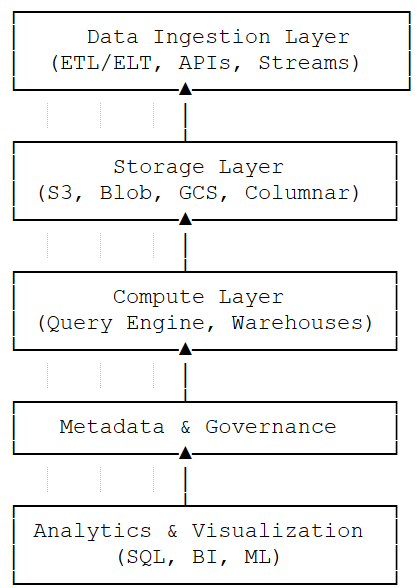
2. Logical Architecture Visual Reference 🖼️
3. Core Architecture Layers 🧱
Data ingestion layer
This layer brings data from source systems into the cloud environment. It may use file loads, database replication, event streaming, APIs, or managed connectors.
Good ingestion design considers:
- batch vs near-real-time needs;
- data volume and frequency;
- schema changes;
- duplicate handling;
- error recovery;
- pipeline monitoring.
Storage layer
The storage layer holds raw, curated, and consumption-ready data. In modern cloud architectures, storage is usually scalable and separated from compute.
This layer should answer:
- What data should be stored raw?
- What data should be transformed?
- How long should data be retained?
- Which data is sensitive?
- Which data must stay in a specific region?
Compute and processing layer
Compute runs queries, transformations, aggregations, and analytical workloads. In modern cloud data warehouses, compute can often be resized, paused, isolated, or scaled based on usage.
This matters because not all workloads behave the same. A dashboard workload, a large transformation job, and a data science experiment may need different compute behavior.
Transformation and modeling layer
Raw data is rarely ready for business use. It must be cleaned, standardized, joined, enriched, and modeled.
This layer creates trusted datasets such as:
- raw/bronze data;
- cleaned/silver data;
- curated/gold data;
- reporting marts;
- dimensional models;
- semantic or business metric layers.
Consumption layer
This is where the business sees value. Users access data through reports, dashboards, self-service SQL, notebooks, APIs, applications, or governed data sharing.
The goal is not just “data availability.” The goal is understandable, trusted, and timely data.
Security, governance, and operations layer
This layer runs across the entire architecture. It includes identity, roles, access policies, encryption, data classification, lineage, auditing, monitoring, alerting, cost controls, and recovery planning.
Without this layer, a cloud data platform can become fast but chaotic. With it, the platform becomes reliable and enterprise-ready.
4. Design Principles for a Strong Cloud Data Warehouse 🧠
Separate storage and compute
Modern cloud data warehouses commonly separate data storage from query processing. This allows teams to scale processing without physically moving the data each time.
The practical benefit is flexibility: one workload can run heavy transformations while another workload supports dashboards, without both always competing for the same fixed machine.
Design for elasticity, not unlimited usage
Elasticity means resources can change with demand. It does not mean cost is unlimited or invisible.
Good teams use budgets, alerts, usage monitoring, workload separation, and sensible scaling rules.
Build from consumption backward
Architecture should begin with business questions:
- Who needs the data?
- What decisions will they make?
- How fresh must the data be?
- What quality level is required?
- What access restrictions apply?
When teams design only from source systems forward, they often create data lakes or warehouses full of data that nobody can confidently use.
Treat governance as part of architecture
Governance is not a final checklist. It belongs in the design from day one.
Data ownership, definitions, lineage, access control, retention, quality rules, and privacy controls should be built into the architecture instead of patched later.
5. Common Cloud Data Warehouse Patterns 🎯
Cloud data warehouse architecture is not one fixed design. Different business needs create different patterns.
- Batch analytics pattern — data is loaded hourly, daily, or weekly for reporting and analysis.
- Near-real-time analytics pattern — events or operational changes are processed quickly for fresher dashboards.
- Self-service BI pattern — curated datasets and semantic definitions help business users explore data safely.
- Data science pattern — curated and historical data supports feature engineering, experimentation, and model development.
- Data sharing pattern — governed datasets are shared between teams, business units, or partners.
- Lakehouse-style pattern — data warehouse capabilities work alongside cloud object storage and open table formats.
The right pattern depends on latency, governance, cost, user skill level, data volume, and business criticality.
6. Cost and Performance Considerations 💰
Cloud architecture gives teams more control, but it also creates more design choices.
Important decisions include:
- choosing the right region;
- separating heavy and light workloads;
- avoiding always-on compute when not needed;
- reducing unnecessary data movement;
- designing efficient data models;
- monitoring slow queries and expensive jobs;
- setting ownership for cost review.
A useful principle:
Performance, cost, and governance should be designed together.
If performance is improved by using more compute, cost may increase. If cost is reduced too aggressively, user experience may suffer. If governance is ignored, both performance and cost become harder to manage because nobody trusts or understands the data.
🏁 Summary
A cloud data warehouse architecture should clearly explain:
- where data comes from;
- how data enters the platform;
- where data is stored;
- how data is processed;
- how data is secured and governed;
- how users consume it;
- how cost and performance are monitored.
The clean mental model is:
Move data carefully, store it scalably, process it elastically, govern it continuously, and deliver it in a form the business can trust.